You’ve heard of the connected car, but this is probably the first time you’ve heard of the ‘connected cow.’ MeTech Holdings is a company that dreams of becoming the Tesla of livestock farming.
That is how Park Chan-mok, CEO of MeTech Holdings, described his company when we met him recently at its headquarters in Samseong-dong, Seoul. As heat waves, torrential rains and other extreme weather events become more frequent, interest in global warming is growing. Industrialization is usually named as the main cause, but livestock farming also plays a significant part.
The greenhouse gases a single cow emits through belching and flatulence are equivalent to the annual emissions of two passenger cars.
Methane, the main component, is known to have a greenhouse effect more than 25 times stronger than carbon dioxide. The world’s roughly 1.5 billion cattle are considered one of the major contributors to the climate crisis, and calls for decarbonization are intensifying. Led by Europe, methane taxes of more than USD 100 per tonne are becoming a reality, and there are growing concerns that livestock unable to prove their carbon emission history could be blocked from export.
The global livestock industry has tried a variety of ways to reduce the methane produced by cattle. Low-carbon feed mixed with seaweed or special additives interfered with fattening, causing farm losses of several million won per head at shipment. Mask-type measuring devices worn over the mouth also caused cattle severe stress.
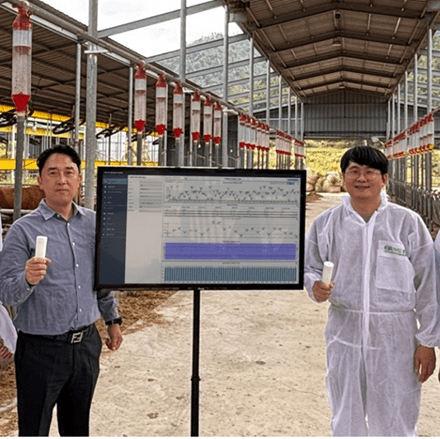
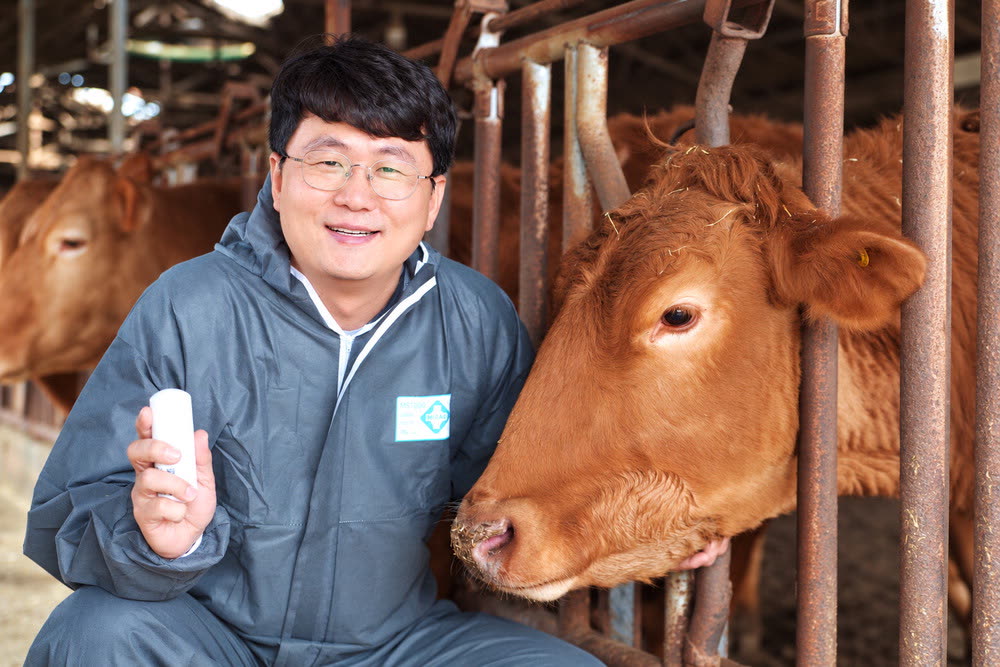
CEO Park, who has 15 years of experience in livestock Internet of Things (IoT), focused on this problem. The first stomach (rumen), which accounts for 80% of a cow’s four stomachs, is not where food is digested but serves as a giant fermentation tank. Microbial fermentation takes place there, and cattle produce methane all day long, releasing it by belching. MeTech Holdings has developed a special measurement capsule that, once swallowed, settles safely at the bottom of the rumen and stays there until slaughter.
The key is methanotrophic bacteria, a technology transferred from the National Institute of Biological Resources under Korea’s Ministry of Environment. When the sensor built into the capsule detects digestive activity in the rumen and the moments when large amounts of gas are produced, the capsule releases methanotrophic bacteria into the stomach about once every two weeks. The bacteria, which feed and multiply on methane, oxidize and break it down into water and carbon dioxide before it is belched out. They are harmless to humans and cattle.
“Farmers can keep fattening their cattle with high-calorie feed as they always have, while the capsule oxidizes up to 30 to 50% of the methane on its own,” Park explained. “It is a way to genuinely reduce methane without hurting farm productivity.” Instead of methanotrophic bacteria, the capsule can also carry various drugs such as vitamins and vaccines.
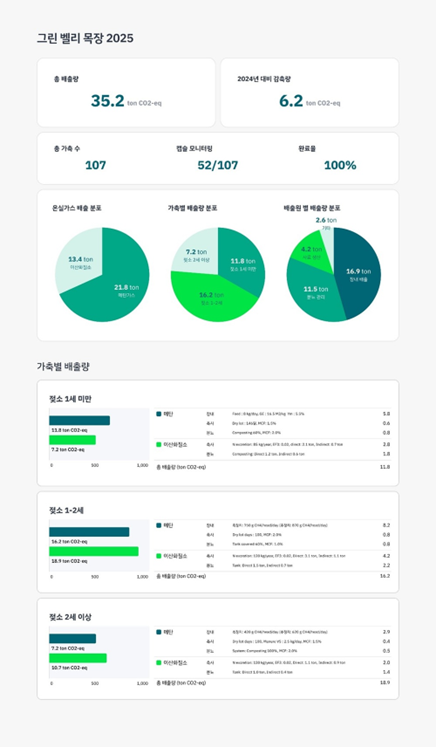
Another core element of MeTech Holdings’ technology is measured data. The capsule transmits data from inside the cow’s stomach more than 120 times a day. Precise body temperature readings to 0.01 degrees, rumen contractions numbering up to 3,000 a day, drinking cycles and feed intake are accumulated as real-time data.
This vast amount of data passes through the company’s own artificial intelligence (AI) engine and evolves into a livestock healthcare solution. It detects warning signs such as a cow not drinking water or a slight rise in body temperature, and alerts farm owners to respiratory and other diseases at an early stage. Recently, the company has advanced its AI analysis to determine the optimal time for insemination and to check for pregnancy or infertility. Park likens this to a black box. “Only tamper-proof measured values showing that living, breathing cattle actually reduced their emissions can convince international organizations and carbon certification bodies,” he stressed.
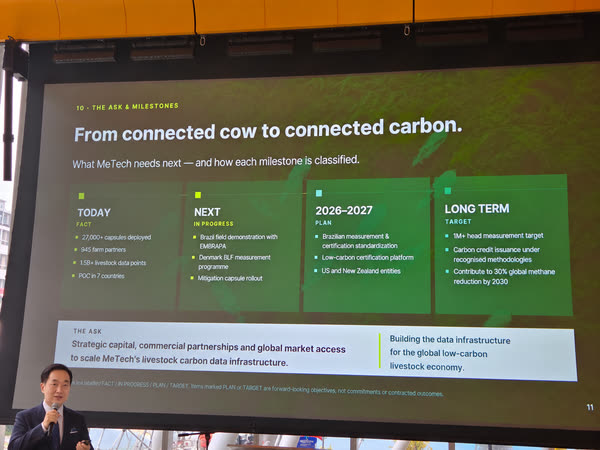
MeTech Holdings’ business model does not stop at selling capsules. Just as Tesla went beyond manufacturing electric vehicles to earn huge profits from trading greenhouse gas regulatory credits, the core strategy is to turn a year’s worth of precise reduction data accumulated per cow into an asset and enter the global carbon credit market. “In 2028, we plan to register our methodology with, and pursue listing on, international voluntary carbon credit exchanges such as Verra and Gold Standard,” Park said. Farmers would recover the cost of adopting the capsule through government subsidies and carbon credit settlements, while the company would earn credit trading fees on top of its capsule margins.
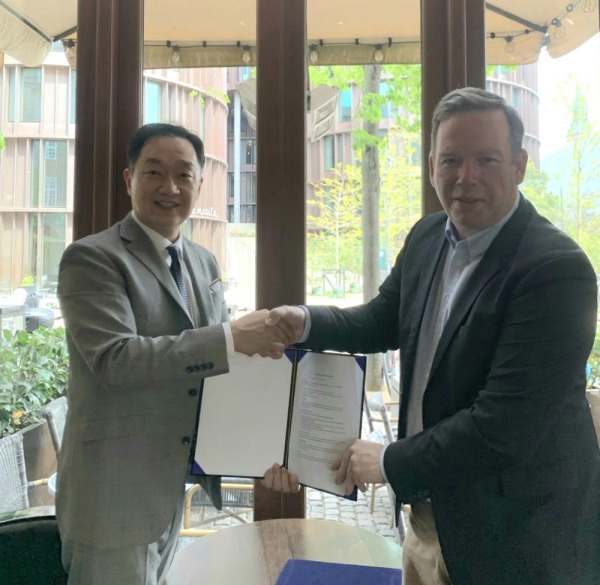
MeTech Holdings is moving quickly in overseas markets. In Brazil, one of the world’s largest livestock countries with about 300 million cattle, it set up a local subsidiary at the same time as establishing its headquarters and is pursuing supply contracts with major livestock belts. It has also signed a partnership with the U.S. Department of Agriculture (USDA) and begun platform demonstrations at very large ranches in states such as Oklahoma and Colorado. In Korea, it continues to work with local governments seeking to support Hanwoo farms raising 3.6 million cattle, in step with the enactment of the Act on the Transition and Support of the Hanwoo Industry for Carbon Neutrality (the Hanwoo Act). The goal is to apply the technology to 100 million cattle worldwide within three years.
Park also expressed his ambition to grow the market by boldly opening up MeTech Holdings’ patents. “Just as Elon Musk accelerated mobility innovation by releasing his electric vehicle patents, we in livestock farming should also open up our data and work together to solve global warming, a challenge shared by all of humanity,” he emphasized.
Source: Maeil Business Newspaper